Hisense continues to expand its premium TV lineup in 2026 with new RGB Mini LED technology designed to deliver brighter pictures, richer colors, and improved HDR performance. Two models worth comparing are the Hisense UR9SG and Hisense UR8SG. Both belong to Hisense’s new RGB Mini LED TV lineup and offer 4K resolution, a native 180Hz refresh rate, advanced gaming features, and Google TV. However, the UR9SG sits above the UR8SG, bringing several upgrades aimed at buyers who want a more premium viewing experience.
Although the UR9SG is positioned above the UR8SG in Hisense’s 2026 lineup, that doesn’t automatically make it the better choice for everyone. The UR9SG is designed to deliver better brightness, contrast, and local dimming performance, while the UR8SG offers many of the same core technologies at a lower position in the lineup. The UR8SG also sits above the more conventional Mini LED Hisense U7SG, making it an interesting option for buyers who want to experience RGB Mini LED technology without stepping up to the flagship UR9SG. So, is the Hisense UR9SG worth the upgrade? Let’s compare their specifications, picture quality, gaming features, sound, and overall value.
Hisense UR9SG (2026) Short Overview
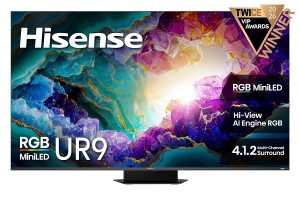
The Hisense UR9SG is the flagship model in Hisense’s 2026 UR series, featuring RGB Mini LED technology designed to deliver exceptional brightness, rich colors, and improved contrast. Unlike many conventional quantum-dot Mini LED TVs that use a blue LED backlight combined with a quantum-dot layer to produce colors, RGB Mini LED uses individually controlled red, green, and blue light sources to produce colors directly. This approach allows the TV to deliver an exceptionally wide color gamut, with Hisense advertising up to 100% BT.2020 color coverage.
One of the UR9SG’s biggest attractions is its impressive brightness and local dimming performance. Its RGB Mini LED system is designed to produce vivid HDR highlights while maintaining deep black levels. Independent testing also indicates that the UR9SG offers better black levels and less blooming than the UR8SG, making it more appealing for viewers who frequently watch movies in dark rooms. However, its RGB technology can introduce some color inaccuracies and color crosstalk in certain scenes, so its more advanced display technology does not guarantee perfect picture accuracy.
The UR9SG is powered by Hisense’s Hi-View AI Engine RGB, which analyzes picture content and optimizes color, brightness, contrast, and detail. It supports 4K resolution and major HDR formats, including Dolby Vision, Dolby Vision IQ, HDR10, HDR10+ Adaptive, and HLG. Its Obsidian Panel coating is designed to reduce reflections and maintain deeper-looking blacks under ambient lighting, although independent testing suggests that reflection handling is not necessarily its strongest feature in every viewing situation.
Gaming is another important strength of the UR9SG. It features a native 180Hz refresh rate, supporting 4K gaming at up to 180Hz and 1080p gaming at up to 330Hz with compatible PC hardware. It also supports Variable Refresh Rate (VRR), Auto Low Latency Mode (ALLM), and AMD FreeSync Premium Pro. Its three HDMI inputs support HDMI 2.1 bandwidth, while a multifunctional USB-C port with DisplayPort Alt Mode provides additional connectivity for compatible computers.
The UR9SG runs Google TV 14, providing access to popular streaming applications, voice control, and personalized content recommendations. It also features Wi-Fi 6E, Dolby Atmos support, and a premium integrated audio system tuned by Devialet. Its 4.1.2-channel speaker configuration is designed to create a more immersive sound experience. In the US market, the UR9SG is available in 65-inch, 75-inch, 85-inch, and 100-inch sizes. Its flagship positioning, advanced RGB Mini LED technology, and premium audio system make it the more ambitious option in this comparison, but it also comes at a higher price.
| Hisense UR9SG Prices | |
| 100-Inch (100UR9SG) | Check Today’s Price… |
| 85-Inch (85UR9SG) | Check Today’s Price… |
| 75-Inch (75UR9SG) | Check Today’s Price… |
| 65-Inch (65UR9SG) | Check Today’s Price… |
Hisense UR8SG (2026) Short Overview
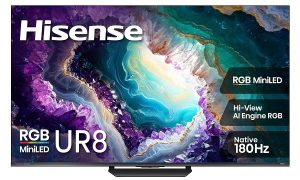
The Hisense UR8SG is an upper-midrange RGB Mini LED TV in Hisense’s 2026 lineup, positioned below the UR9SG and above the more conventional U7SG. It is also the most affordable model in Hisense’s new RGB Mini LED range, making it an interesting alternative for buyers who want to experience this newer display technology without paying for the flagship UR9SG.
Like the UR9SG, the UR8SG uses RGB Mini LED technology, with independently controlled red, green, and blue light sources designed to produce vivid colors and a wide color gamut. Its Hi-View AI Engine RGB processor works to optimize color and brightness in real time, helping improve picture detail and overall visual presentation. However, its local dimming performance is not as refined as the UR9SG, particularly when displaying dark scenes with bright objects. Independent testing indicates that the UR8SG produces more visible blooming and less impressive black levels than its more expensive sibling.
The UR8SG also features Hisense’s Obsidian Panel coating, which is designed to reduce reflections while preserving deeper-looking blacks in brighter environments. It supports 4K resolution and major HDR formats, including Dolby Vision, Dolby Vision IQ, HDR10, HDR10+ Adaptive, and HLG. Its RGB Mini LED backlight can produce particularly vivid and punchy colors, although color accuracy and color crosstalk can be concerns in some viewing situations.
For gaming, the UR8SG is equipped with a native 180Hz refresh rate, matching the UR9SG. It supports 4K gaming at up to 180Hz and 1080p gaming at up to 330Hz with compatible devices. Other gaming features include VRR, ALLM, and AMD FreeSync Premium Pro. One connectivity advantage over the UR9SG is that the UR8SG comes with four HDMI 2.1 inputs instead of three, making it more convenient for users who connect several gaming devices. It also offers USB-C connectivity with DisplayPort functionality.
The UR8SG runs Google TV 14, giving users access to a wide selection of streaming applications and smart features. Its built-in audio system features a 2.1.2-channel configuration tuned by Devialet, with Dolby Atmos support. The UR8SG is available in 55-inch, 65-inch, 75-inch, 85-inch, and 100-inch sizes in the US market. Its additional 55-inch option, four HDMI 2.1 inputs, and lower position in Hisense’s lineup make it an attractive alternative for buyers who want RGB Mini LED technology while keeping their budget under control.
Hisense UR9SG vs UR8SG Specs Comparison
Here’s a quick side-by-side look at how these two Hisense RGB Mini LED televisions compare.
| Feature | Hisense UR9SG | Hisense UR8SG | |||||||||
| Model Year | 2026 | 2026 | |||||||||
| Position in Lineup | Flagship RGB Mini LED TV | Upper-midrange RGB Mini LED TV | |||||||||
| Position Relative to U7SG | Above UR8SG and U7SG | Above U7SG | |||||||||
| Available Sizes (US) | 65″, 75″, 85″, 100″ | 55″, 65″, 75″, 85″, 100″ | |||||||||
| Resolution | 3840 × 2160 (4K) | 3840 × 2160 (4K) | |||||||||
| Display Technology | RGB Mini LED LCD | RGB Mini LED LCD | |||||||||
| Backlight | RGB Mini LED with local dimming | RGB Mini LED with local dimming | |||||||||
| Picture Processor | Hi-View AI Engine RGB | Hi-View AI Engine RGB | |||||||||
| Panel Coating | Obsidian Panel | Obsidian Panel | |||||||||
| Black Level | Better, with less blooming | Good, with more noticeable blooming | |||||||||
| Peak Brightness | Higher | Lower | |||||||||
| Color Technology | RGB Mini LED | RGB Mini LED | |||||||||
| HDR Formats | Dolby Vision, Dolby Vision IQ, HDR10, HDR10+ Adaptive, HLG | Dolby Vision, Dolby Vision IQ, HDR10, HDR10+ Adaptive, HLG | |||||||||
| Native Refresh Rate | 180Hz | 180Hz | |||||||||
| Maximum 4K Refresh Rate | 180Hz | 180Hz | |||||||||
| Maximum 1080p Refresh Rate | 330Hz | 330Hz | |||||||||
| VRR | Yes | Yes | |||||||||
| ALLM | Yes | Yes | |||||||||
| AMD FreeSync Premium Pro | Yes | Yes | |||||||||
| HDMI Inputs | 3 | 4 | |||||||||
| HDMI 2.1 Gaming Features | Yes, all 3 ports | Yes, all 4 ports | |||||||||
| USB-C DisplayPort | Yes | Yes | |||||||||
| Smart Platform | Google TV 14 | Google TV 14 | |||||||||
| Dolby Atmos | Yes | Yes | |||||||||
| Built-in Audio | 4.1.2-channel, tuned by Devialet | 2.1.2-channel, tuned by Devialet | |||||||||
| Wi-Fi | Wi-Fi 6E | Wi-Fi 6E | |||||||||
| Best Viewing Environment | Bright and dark rooms; better dark-scene performance | Bright and dark rooms; more noticeable blooming | |||||||||
| Main Advantage | Better contrast, brightness, and local dimming | More affordable RGB Mini LED, four HDMI 2.1 ports | |||||||||
| Main Compromise | Higher price and fewer HDMI inputs | Less impressive black levels and local dimming | |||||||||
| Price |
|
|
The Differences Between Hisense UR9SG and UR8SG
Although the Hisense UR9SG and UR8SG share several important features, including RGB Mini LED technology, 4K resolution, a native 180Hz refresh rate, and Google TV, their different positions in Hisense’s lineup create some meaningful differences. Here’s how they compare in the areas that matter most when choosing a new TV.
1. Display Technology: RGB Mini LED
Both televisions use RGB Mini LED technology, which is one of the main attractions of Hisense’s 2026 premium TV lineup. Unlike many conventional quantum-dot Mini LED TVs that use a blue LED backlight combined with a quantum-dot layer to produce colors, RGB Mini LED uses individually controlled red, green, and blue light sources to produce colors directly.
This approach is designed to improve color volume and deliver more vibrant images, particularly when displaying demanding HDR content. Both models also use local dimming to control brightness across different screen areas, helping improve contrast and black-level performance.
However, the UR9SG has an advantage in overall picture performance. Independent testing indicates that its local dimming system delivers deeper blacks and less blooming around bright objects than the UR8SG. This is particularly noticeable when watching movies with dark backgrounds, subtitles, or bright highlights.
The UR8SG still delivers impressive color reproduction, but its local dimming performance is less refined. Its more visible blooming can reduce the impact of dark scenes, especially when watching movies in a dimly lit room.
Winner: Hisense UR9SG. Both use RGB Mini LED, but the UR9SG delivers better black levels and more refined local dimming.
2. Brightness and HDR Performance
Brightness is another important difference between these televisions. The Hisense UR9SG delivers higher peak brightness than the UR8SG, allowing bright highlights to stand out more prominently in HDR movies, sports, and other demanding content.
Its RGB Mini LED backlight is designed to deliver intense highlights while maintaining rich colors. This makes it particularly appealing for viewers who want an impactful HDR experience, especially when watching content with bright outdoor scenes, sunlight, and other high-intensity highlights.
The UR8SG is also a very bright television, so it is not necessarily a weak choice for HDR viewing. Its RGB Mini LED technology produces vivid colors and impressive brightness, making it suitable for everyday entertainment in rooms with moderate ambient light. However, it cannot match the UR9SG’s higher peak brightness.
Both televisions support Dolby Vision, Dolby Vision IQ, HDR10, HDR10+ Adaptive, and HLG. Therefore, the main difference is not HDR format compatibility but how effectively their display systems reproduce HDR content.
Winner: Hisense UR9SG. Its higher peak brightness gives it an advantage for HDR highlights and viewing in brighter environments.
3. Black Levels, Contrast, and Blooming
Black-level performance is one of the areas where the UR9SG has a more meaningful advantage. Both models use RGB Mini LED backlighting with local dimming, but the UR9SG offers better control over its lighting zones.
This allows it to produce deeper blacks and reduce the halo-like blooming that can appear around bright objects against dark backgrounds. For example, when watching a movie with subtitles or stars against a dark sky, the UR9SG can maintain better separation between bright and dark areas.
The UR8SG also uses local dimming, but independent testing indicates that its black levels are noticeably weaker. Bright objects can create more visible halos, which can become distracting when watching movies in a dark room.
Neither television offers the pixel-level light control of OLED technology, so some blooming can still occur. However, the UR9SG is the better performer between these two models.
Winner: Hisense UR9SG. It delivers deeper blacks and less noticeable blooming, making it better for dark-room viewing.
4. Color Reproduction
Color reproduction is one of the main reasons to consider either of these RGB Mini LED televisions. Both models use individually controlled red, green, and blue light sources to produce vivid colors and improve color volume compared with conventional Mini LED technology.
The UR9SG is designed to deliver particularly impressive color performance at high brightness levels. Its RGB backlight can produce intense reds, greens, and blues, helping HDR content look vibrant and visually engaging.
The UR8SG also benefits from the same basic RGB Mini LED approach. It can produce punchy and saturated colors, making movies, animation, sports, and other colorful content look lively.
However, there is an important consideration with both models. RGB Mini LED technology can introduce color crosstalk, where nearby colors influence one another and cause certain bright areas to take on unwanted color tints. Independent testing has also identified out-of-the-box color accuracy as an area that could be improved on both televisions, with the UR8SG showing more noticeable color crosstalk.
The UR9SG delivers better overall color volume and more refined picture performance, but buyers who prioritize color accuracy should consider professional calibration for either model.
Winner: Hisense UR9SG. It offers stronger overall color and picture performance, although both models share some of the limitations of early-generation RGB Mini LED technology.
5. Refresh Rate and Gaming Performance
Gaming is an area where the two televisions are remarkably similar. Both feature a native 180Hz refresh rate, supporting 4K gaming at up to 180Hz and 1080p gaming at up to 330Hz with compatible PC hardware.
They also support VRR, ALLM, and AMD FreeSync Premium Pro, helping reduce screen tearing and input latency while providing smoother gameplay. These features make both televisions suitable for modern gaming PCs and consoles.
However, there is an important distinction regarding gaming hardware. The PlayStation 5 and Xbox Series X generally support gaming at up to 120Hz, so their owners will not fully utilize the televisions’ 180Hz capabilities. The higher refresh rate is particularly useful for compatible gaming PCs.
Both models also provide HDMI 2.1 connectivity, but the UR8SG has four HDMI 2.1 inputs, compared with three on the UR9SG. This gives the UR8SG a practical advantage if you regularly connect multiple consoles, computers, and other high-bandwidth devices.
Winner: Tie for core gaming performance. Both offer the same 180Hz refresh rate and major gaming technologies, while the UR8SG provides an additional HDMI 2.1 input.
6. Anti-Reflection Performance and Viewing Environment
Both Hisense televisions feature the company’s Obsidian Panel coating, designed to reduce reflections and maintain deeper-looking blacks in rooms with ambient lighting.
This is an important feature because reflections can reduce the perceived contrast of a television, particularly when watching dark scenes during the day. A panel coating that absorbs or minimizes ambient light can help maintain a more enjoyable viewing experience.
However, neither model should automatically be considered reflection-free. Independent testing indicates that the UR9SG’s reflection handling can still be a limitation, especially when direct light sources are positioned in front of the screen.
The UR9SG benefits from its higher peak brightness, which helps bright content remain visible in well-lit rooms. The UR8SG also delivers strong brightness, but it does not have the same level of brightness headroom.
For viewers who frequently watch movies in a dark room, the UR9SG’s better black levels and reduced blooming are more important advantages. For daytime viewing, both models can work well, although room lighting and screen placement remain important considerations.
Winner: Hisense UR9SG. Its higher brightness and better contrast give it an overall advantage, although neither model is completely immune to reflections.
7. Audio Quality
Hisense equips both televisions with premium built-in audio systems tuned by Devialet, but their speaker configurations are different.
The UR9SG features a 4.1.2-channel audio system, designed to provide more dimensional sound with dedicated channels for a wider soundstage and height effects. This configuration is intended to create a more immersive listening experience when watching movies and other Dolby Atmos content.
The UR8SG uses a 2.1.2-channel speaker configuration, which also supports Dolby Atmos and is designed to deliver a more spacious sound experience than conventional stereo television speakers.
Both televisions offer an integrated audio solution that can be convenient for buyers who do not want to purchase a separate soundbar immediately. However, a dedicated soundbar or home theater system can still provide a more convincing surround experience and stronger bass.
Winner: Hisense UR9SG. Its more advanced 4.1.2-channel speaker configuration gives it an advantage over the UR8SG’s 2.1.2-channel system.
8. Available Screen Sizes
Screen-size selection is another practical difference between these two models.
The Hisense UR9SG is available in 65-inch, 75-inch, 85-inch, and 100-inch versions in the US market. This makes it suitable for buyers who want a premium large-screen television for a spacious living room or home theater.
The UR8SG offers a slightly wider selection, with 55-inch, 65-inch, 75-inch, 85-inch, and 100-inch versions. Its additional 55-inch option makes it more suitable for smaller living rooms and bedrooms.
Both televisions offer a 100-inch option, so buyers looking for an extremely large RGB Mini LED screen can choose either model. However, if you want a 55-inch RGB Mini LED television, the UR8SG is the only option in this comparison.
Winner: Hisense UR8SG. Its additional 55-inch option provides greater flexibility for buyers who need a smaller television.
9. HDMI Connectivity
Connectivity is one area where the less expensive UR8SG actually has an advantage.
The Hisense UR9SG comes with three HDMI inputs, all supporting HDMI 2.1 bandwidth. This is sufficient for most users, but it can become limiting if you connect multiple gaming consoles, a gaming PC, and an external audio system.
The UR8SG provides four HDMI 2.1 inputs, allowing more devices to remain connected simultaneously without frequently switching cables.
Both televisions also support USB-C connectivity with DisplayPort functionality, providing an additional connection option for compatible computers.
For users with multiple gaming devices, the UR8SG’s fourth HDMI input is a meaningful convenience. However, buyers who only connect one or two major HDMI devices are unlikely to find the UR9SG’s three inputs particularly restrictive.
Winner: Hisense UR8SG. Four HDMI 2.1 inputs make it more flexible for multi-device setups.
10. Price and Overall Value
The Hisense UR9SG is positioned as the flagship model in the 2026 UR series, so it generally commands a higher price than the UR8SG. Its better local dimming, higher peak brightness, improved black levels, and more advanced built-in audio system help justify its premium positioning.
The UR8SG is designed for buyers who want to experience RGB Mini LED technology at a lower price. It shares several important features with the UR9SG, including 4K resolution, a native 180Hz refresh rate, VRR, AMD FreeSync Premium Pro, and Google TV 14.
The UR8SG also offers practical advantages such as four HDMI 2.1 inputs and a 55-inch screen-size option. These features can make it a more sensible purchase if you do not need the UR9SG’s improvements in picture quality and audio performance.
However, the price difference between the two models is important. If the UR9SG is available at a relatively small premium, its better contrast, brightness, and local dimming may justify the additional investment. If the price gap is substantial, the UR8SG can still provide a compelling RGB Mini LED experience.
Winner: Depends on the price difference. The UR8SG is better for budget-conscious buyers, while the UR9SG offers more premium picture and audio performance.
Which One Should You Choose?
If you want the better overall picture quality and a more premium entertainment experience, the Hisense UR9SG is the one to choose. Its RGB Mini LED technology is supported by better local dimming performance, deeper black levels, less blooming, and higher peak brightness. These improvements make it particularly attractive for movie enthusiasts who want impressive HDR performance in both bright and dark viewing environments. Its 4.1.2-channel audio system is another advantage, while its 180Hz refresh rate, VRR, AMD FreeSync Premium Pro, and Google TV 14 provide an excellent collection of entertainment and gaming features.
Hisense UR9SG — Best for better picture quality, deeper blacks, higher brightness, and premium built-in audio.
However, the Hisense UR8SG remains an attractive alternative for buyers who want RGB Mini LED technology at a more affordable price. It shares the UR9SG’s 180Hz refresh rate, major gaming features, HDR format support, and Google TV platform. It also offers four HDMI 2.1 inputs and an additional 55-inch screen-size option. Although its black levels and local dimming performance are not as impressive as those of the UR9SG, it still offers plenty of features for everyday entertainment and gaming.
Hisense UR8SG — Best for more affordable RGB Mini LED technology, flexible screen sizes, and additional HDMI connectivity.
| Hisense UR8SG Prices | |
| 100-Inch (100UR8SG) | Check Today’s Price… |
| 85-Inch (85UR8SG) | Check Today’s Price… |
| 75-Inch (75UR8SG) | Check Today’s Price… |
| 65-Inch (65UR8SG) | Check Today’s Price… |
| 55-Inch (55UR8SG) | Check Today’s Price… |