The Hisense UR8SG and Hisense U7SG are two interesting televisions in Hisense’s 2026 TV lineup, offering advanced Mini LED display technology, 4K resolution, and extensive gaming features. The Hisense UR8SG is positioned above the U7SG and introduces RGB Mini LED technology, which is designed to deliver a wider color volume and more vibrant colors. Meanwhile, the Hisense U7SG is the successor to the Hisense U75QG and is positioned above the Hisense U6SF Pro. It uses conventional Mini LED backlighting with quantum dot color technology. Hisense also offers the U7SF as the Fire TV version of the U7SG, providing an alternative for buyers who prefer Amazon’s smart TV platform over Google TV.
Although the UR8SG comes with more advanced RGB Mini LED technology and a higher position in Hisense’s lineup, that doesn’t necessarily make it the better choice for everyone. The U7SG remains a compelling alternative with impressive brightness, effective local dimming, a matte anti-reflection screen on its 55–85-inch models, and excellent gaming capabilities. It may also offer better value for buyers who don’t specifically need RGB Mini LED technology. So, should you choose the Hisense UR8SG over the U7SG, or is the more affordable U7SG already good enough? Let’s compare their specifications, picture quality, gaming features, and overall value.
Hisense UR8SG (2026) Short Overview
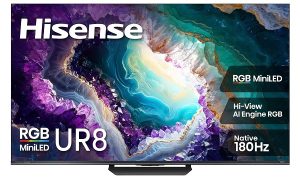
The Hisense UR8SG is an upper-midrange television in Hisense’s 2026 lineup, sitting below the UR9SG and above the U7SG. It is one of Hisense’s more affordable ways to experience RGB Mini LED technology, which uses dedicated red, green, and blue LEDs in its backlighting system instead of relying on conventional Mini LED backlighting with quantum dot color enhancement.
One of the biggest attractions of the UR8SG is its RGB Mini LED technology, which is designed to deliver a wider color volume and more vibrant colors, particularly in high-brightness HDR scenes. It combines this technology with a 4K LCD panel and local dimming, allowing it to produce bright highlights while maintaining good contrast. Its Obsidian panel coating is also designed to improve reflection handling while maintaining deeper blacks in brighter environments, although direct reflections can still be noticeable when watching dark content.
The UR8SG supports 4K resolution and HDR formats, including Dolby Vision and HDR10+. Its RGB Mini LED system delivers impressive color intensity, while local dimming helps produce deeper blacks. However, local dimming still operates in zones rather than at the individual-pixel level, meaning some blooming around bright objects and subtitles can remain visible. Its color accuracy may also benefit from calibration, particularly when watching content in its default picture settings.
For gaming, the Hisense UR8SG features a native 180Hz refresh rate, with support for Variable Refresh Rate (VRR) and HDMI 2.1 across all four HDMI inputs. It can support up to 4K at 180Hz or 1080p at 330Hz, making it particularly attractive to PC gamers who want a high-refresh-rate gaming experience. Console gamers can also take advantage of 4K at 120Hz, ALLM, and VRR.
The UR8SG runs Google TV 14, providing access to popular streaming applications, voice control, and other smart entertainment features. It also features a 2.1.2-channel, 50W audio system tuned by Devialet, providing a more immersive sound experience with Dolby Atmos support. It is available in 55-inch, 65-inch, 75-inch, 85-inch, and 100-inch sizes in the US market. Overall, the UR8SG is an interesting option for buyers who want to experience RGB Mini LED technology without moving to Hisense’s more expensive UR9SG.
| Hisense UR8SG Prices | |
| 100-Inch (100UR8SG) | Check Today’s Price… |
| 85-Inch (85UR8SG) | Check Today’s Price… |
| 75-Inch (75UR8SG) | Check Today’s Price… |
| 65-Inch (65UR8SG) | Check Today’s Price… |
| 55-Inch (55UR8SG) | Check Today’s Price… |
Hisense U7SG (2026) Short Overview
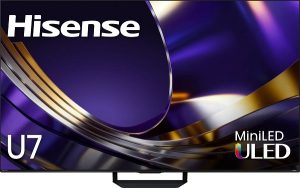
The Hisense U7SG is a mid-range Mini LED television introduced as part of Hisense’s 2026 lineup. It is the successor to the 2025 Hisense U75QG and is positioned above the Hisense U6SF Pro. Unlike the UR8SG, which introduces RGB Mini LED technology, the U7SG uses conventional Mini LED backlighting combined with quantum dot color technology.
One of the U7SG’s biggest strengths is its combination of high brightness and effective local dimming. Its Mini LED backlight is designed to produce bright HDR highlights while maintaining deep blacks and good contrast. It also features a matte anti-reflection screen coating on its 55-inch, 65-inch, 75-inch, and 85-inch models, which significantly reduces direct reflections and makes these versions particularly suitable for rooms with considerable ambient light. However, the 100-inch and 116-inch models use a glossy screen coating, so their reflection handling is different.
The U7SG supports 4K resolution and HDR formats, including Dolby Vision, HDR10+, and HLG. Its quantum dot technology helps deliver bright, vibrant colors, while its local dimming system improves contrast by controlling different areas of the backlight independently. Compared with the UR8SG, it doesn’t have the same RGB Mini LED technology, but its conventional Mini LED system can still produce impressive picture quality. Its local dimming performance also helps deliver deeper blacks with relatively little blooming around bright objects.
For gaming, the Hisense U7SG features a native 165Hz refresh rate, supporting 4K at 165Hz and up to 330Hz at 1080p. It also includes VRR, ALLM, AMD FreeSync Premium Pro, and four HDMI 2.1 inputs with full bandwidth. These features make it a versatile choice for both modern gaming consoles and compatible gaming PCs.
The U7SG also runs Google TV, offering a familiar smart TV interface with access to popular streaming services and applications. The U7SG is available in 55-inch, 65-inch, 75-inch, 85-inch, 100-inch, and 116-inch sizes in the US market.
Overall, the Hisense U7SG remains a strong all-round Mini LED television. Although it doesn’t introduce RGB Mini LED technology like the UR8SG, its high brightness, matte anti-reflection coating on the 55–85-inch models, extensive gaming features, and wide selection of screen sizes make it an attractive option for buyers who want premium features without necessarily paying more for RGB backlighting.
| Hisense U7SG Prices | |
| 116-Inch (116U7SG) | Check Today’s Price… |
| 100-Inch (100U7SG) | Check Today’s Price (Amazon.com)… |
| 85-Inch (85U7SG) | Check Today’s Price (Amazon.com)… |
| 75-Inch (75U7SG) | Check Today’s Price (Amazon.com)… |
| 65-Inch (65U7SG) | Check Today’s Price (Amazon.com)… |
| 55-Inch (55U7SG) | Check Today’s Price… |
Hisense UR8SG vs U7SG Specs Comparison
Here’s a quick side-by-side look at how these two Hisense televisions compare.
| Feature | Hisense UR8SG | Hisense U7SG | |||||||||||
| Model Year | 2026 | 2026 | |||||||||||
| Position in Lineup | Upper-midrange RGB Mini LED TV; below UR9SG | Mid-range Mini LED TV; above U6SF Pro | |||||||||||
| Previous Generation | New RGB Mini LED series | Successor to U75QG | |||||||||||
| Available Sizes (US) | 55″, 65″, 75″, 85″, 100″ | 55″, 65″, 75″, 85″, 100″, 116″ | |||||||||||
| Resolution | 3840 × 2160 (4K) | 3840 × 2160 (4K) | |||||||||||
| Display Technology | RGB Mini LED LCD | Mini LED QLED | |||||||||||
| Backlight | RGB LED backlight with local dimming | Mini LED backlight with local dimming | |||||||||||
| Color Technology | RGB Mini LED | Quantum Dot | |||||||||||
| Panel Coating | Obsidian | Matte (55–85″); Glossy (100/116″) | |||||||||||
| Picture Processor | Hi-View AI Engine RGB | Hi-View AI Engine Pro | |||||||||||
| Black Level | Good, with possible blooming | Excellent, with relatively little blooming | |||||||||||
| Color Volume | Very high | High | |||||||||||
| Peak Brightness | Very high | Up to 2,000–4,000 nits, depending on screen size | |||||||||||
| HDR Formats | Dolby Vision, Dolby Vision IQ, HDR10, HDR10+ Adaptive, HLG | Dolby Vision, Dolby Vision IQ, HDR10, HDR10+ Adaptive, HLG | |||||||||||
| Native Refresh Rate | 180Hz | 165Hz | |||||||||||
| VRR | Yes | Yes | |||||||||||
| ALLM | Yes | Yes | |||||||||||
| AMD FreeSync Premium Pro | Yes | Yes | |||||||||||
| HDMI Inputs | 4 | 4 | |||||||||||
| HDMI 2.1 Gaming Features | Yes, all 4 ports | Yes, all 4 ports | |||||||||||
| Maximum 4K Refresh Rate | 180Hz | 165Hz | |||||||||||
| Maximum 1080p Refresh Rate | 330Hz | 330Hz | |||||||||||
| Smart Platform | Google TV 14 | Google TV | |||||||||||
| Built-in Audio | 2.1.2-channel, 50W | 55–85″: 2.1.2-channel, 50W; 100″: 2.1.2-channel, 60W; 116″: 6.2.2-channel | |||||||||||
| Dolby Atmos | Yes | Yes | |||||||||||
| Best Viewing Environment | Bright and mixed-light rooms | Bright rooms and mixed lighting | |||||||||||
| Main Advantage | RGB Mini LED color volume and high refresh rate | Matte screen (55–85-inch models), contrast, and gaming features | |||||||||||
| Main Compromise | Color accuracy and reflection handling may need improvement | No RGB Mini LED; lower maximum refresh rate | |||||||||||
| Price |
|
|
The Differences Between Hisense UR8SG and U7SG
Although the Hisense UR8SG and U7SG share several important features, including 4K resolution, local dimming, HDR support, and advanced gaming capabilities, their different display technologies and positioning create some meaningful differences. Here’s how they compare in the areas that matter most when choosing a new TV.
1. Display Technology: RGB Mini LED vs Conventional Mini LED
The biggest difference between these televisions is their display technology. The Hisense UR8SG uses RGB Mini LED technology, while the Hisense U7SG uses conventional Mini LED backlighting combined with quantum dot color technology.
The UR8SG’s RGB Mini LED system uses dedicated red, green, and blue LEDs to produce light. This approach is designed to expand color volume and deliver more vivid colors, especially when displaying bright HDR content. Rather than relying on a conventional backlight and quantum dot layer, RGB Mini LED uses individual color light sources to create a wider range of colors at high brightness levels.
The U7SG takes a more conventional approach. Its Mini LED backlight uses local dimming to control brightness across different zones, while quantum dot technology enhances its color reproduction. This combination is already capable of producing bright, colorful images and impressive contrast without requiring the more advanced RGB Mini LED system.
In practical use, the UR8SG has the advantage in color volume and the potential to deliver more vibrant HDR images. However, the U7SG’s conventional Mini LED system remains very capable, and RGB Mini LED does not automatically guarantee better overall picture quality in every situation.
Winner: Hisense UR8SG for RGB Mini LED technology and color volume.
2. Brightness and HDR Performance
Both televisions are designed to deliver high brightness, making them suitable for HDR movies, sports, and daytime viewing. However, their approaches to brightness and HDR reproduction are somewhat different.
The Hisense UR8SG combines RGB Mini LED technology with local dimming to produce bright highlights and vivid colors. Its high color volume is particularly useful for HDR scenes containing bright, saturated colors. This allows colorful highlights to retain their intensity rather than appearing washed out as brightness increases.
The Hisense U7SG also delivers impressive HDR brightness. Its conventional Mini LED backlight can produce bright highlights, while its quantum dot technology helps maintain vibrant colors. It is particularly capable of displaying HDR content in brighter environments, although it doesn’t have the same RGB-based color reproduction approach as the UR8SG.
Both models support Dolby Vision and HDR10+, so they offer broad compatibility with modern HDR content. The main difference is how they reproduce that content rather than the number of HDR formats they support.
The UR8SG is more appealing if you prioritize RGB Mini LED’s high-brightness color reproduction, while the U7SG remains an excellent choice for buyers who want impressive HDR performance without moving to RGB Mini LED.
Winner: Hisense UR8SG for RGB Mini LED color volume; both offer impressive HDR brightness.
3. Black Levels, Contrast, and Local Dimming
Black levels and contrast are important considerations, especially when watching movies in a dark room. Both televisions use local dimming to improve contrast, but their real-world performance is not necessarily identical.
The Hisense UR8SG uses RGB Mini LED backlighting with local dimming. It can produce fairly deep blacks, and its local dimming system helps dark scenes maintain good contrast. However, independent testing has found noticeable blooming around bright objects and subtitles. This means that some light can spill into neighboring dark areas, reducing the depth of blacks in certain scenes.
The U7SG also uses local dimming, but its conventional Mini LED backlight performs particularly well in this area. Its black levels are deep and relatively uniform, with little visible haloing around bright highlights in most scenes. This gives it an advantage for watching movies with dark backgrounds and bright objects.
Interestingly, the more advanced RGB Mini LED technology of the UR8SG doesn’t automatically make it superior in contrast performance. The U7SG’s local dimming implementation can actually deliver a more controlled black-level presentation.
Winner: Hisense U7SG for black levels and local dimming performance.
4. Color Reproduction
Color reproduction is one of the areas where the Hisense UR8SG has a clear technological advantage. Its RGB Mini LED system is designed to deliver a wider color volume, allowing it to reproduce vivid and saturated colors at high brightness levels.
This is particularly beneficial for HDR movies and other content with colorful highlights. The UR8SG can produce very vibrant colors, giving bright scenes an impressive appearance. However, independent testing has also identified some color accuracy issues out of the box, including color tinting and crosstalk in certain situations. Buyers who prioritize accurate color reproduction may want to spend time adjusting its picture settings or consider professional calibration.
The Hisense U7SG uses quantum dot technology to enhance its color reproduction. It can produce bright and vibrant colors across different types of content, and its SDR color accuracy is particularly good out of the box. Its HDR color temperature, however, can be overly cool with the default settings.
The UR8SG has the advantage in color volume, while the U7SG remains a very capable television with vibrant colors and good SDR accuracy. If you prioritize the intensity of bright HDR colors, the UR8SG is more appealing. If you prefer a more conventional quantum dot display with good out-of-the-box SDR accuracy, the U7SG is still a strong option.
Winner: Hisense UR8SG for color volume; Hisense U7SG for out-of-the-box SDR color accuracy.
5. Refresh Rate and Gaming Performance
Gaming is another area where both televisions offer impressive specifications. The Hisense UR8SG features a native 180Hz refresh rate, while the Hisense U7SG features a native 165Hz refresh rate. Both support up to 330Hz at 1080p.
Both models also support VRR and ALLM, helping reduce screen tearing and input lag during gaming. They also feature four HDMI 2.1 inputs, with full HDMI 2.1 bandwidth available across all four ports. This is particularly convenient if you connect multiple gaming devices and other high-bandwidth equipment.
For PC gamers, the UR8SG’s 180Hz refresh rate provides a small advantage over the U7SG’s 165Hz refresh rate. Both televisions can also deliver 4K gaming at high refresh rates, making them suitable for compatible gaming PCs. Console gamers, however, are unlikely to notice a meaningful difference from the additional 15Hz because current consoles generally top out at 120Hz.
The U7SG remains a very capable gaming television, with low input lag, VRR, and FreeSync Premium Pro. The UR8SG also offers a comprehensive gaming feature set, although independent testing indicates that some motion blur can still be visible in fast-paced games.
Winner: Hisense UR8SG for its higher 180Hz native refresh rate; both are excellent for modern console gaming.
6. Anti-Reflection Performance and Viewing Environment
Both televisions are designed for bright-room viewing, but their screen coatings take different approaches to managing reflections.
The Hisense UR8SG features Hisense’s Obsidian panel coating, which is designed to improve reflection handling while maintaining deeper blacks in brighter environments. However, independent testing indicates that direct reflections can still be noticeable, particularly when watching dark scenes with light sources facing the screen.
The 55-inch to 85-inch versions of the U7SG use a matte anti-reflection screen coating. This is one of their strongest features because it significantly reduces direct reflections, making the picture easier to see in brightly lit rooms. However, the 100-inch and 116-inch versions use glossy coatings, so they don’t offer the same reflection-handling advantage.
This makes the U7SG particularly interesting for living rooms with windows, ceiling lights, or other sources of ambient light. Although the UR8SG has advanced RGB Mini LED technology, the U7SG’s matte coating can provide a more practical advantage in environments where reflection handling is a priority.
Winner: Hisense U7SG (55–85-inch models) for direct reflection handling.
7. Available Screen Sizes
Screen-size selection is another practical difference between these two televisions.
The Hisense UR8SG is available in 55-inch, 65-inch, 75-inch, 85-inch, and 100-inch sizes. This provides several options for different room sizes, although it doesn’t extend into the very large 116-inch category.
The Hisense U7SG offers a wider range of sizes, including 55-inch, 65-inch, 75-inch, 85-inch, 100-inch, and 116-inch versions. This makes it more flexible for buyers who want a particularly large television for a spacious living room or home entertainment setup.
If you want a screen larger than 100 inches, the U7SG is the only option between these two models. For buyers choosing between the more common 55-inch to 100-inch sizes, both televisions provide a similar range of options.
Winner: Hisense U7SG for its additional 116-inch option.
8. Price and Overall Value
The Hisense UR8SG occupies a higher position in Hisense’s 2026 lineup and introduces RGB Mini LED technology. Its more advanced backlighting system, wider color volume, and 180Hz native refresh rate make it an interesting option for buyers who want newer display technology.
However, these advantages may come with a higher price. The UR8SG is positioned above the U7SG, so buyers should expect to pay more for its RGB Mini LED technology, although actual retail prices will depend on screen size, retailer, and promotional discounts.
The Hisense U7SG offers a different value proposition. It uses conventional Mini LED technology but still provides high brightness, excellent contrast, a matte anti-reflection screen on its 55–85-inch models, and extensive gaming features. It also offers a wider screen-size selection, including a 116-inch option.
For buyers who don’t specifically need RGB Mini LED technology, the U7SG may deliver a more balanced overall experience. Its reflection handling, local dimming performance, and gaming specifications make it a strong alternative, especially if its price is considerably lower.
Winner: Hisense U7SG for overall value; Hisense UR8SG for buyers who specifically want RGB Mini LED technology.
Should You Choose Hisense UR8SG?
If you want the more advanced display technology between these two televisions, the Hisense UR8SG is the one to choose. Its RGB Mini LED technology is designed to deliver a wider color volume and more vibrant colors, particularly when watching HDR content. It also features a native 180Hz refresh rate, making it slightly more attractive for PC gaming than the U7SG. Its 4K resolution, Dolby Vision support, VRR, and four full-bandwidth HDMI 2.1 ports make it a well-equipped television for modern entertainment and gaming. If you prioritize newer display technology, high-brightness color reproduction, and high-refresh-rate gaming, the UR8SG is worth choosing over the U7SG.
| Hisense UR8SG Prices | |
| 100-Inch (100UR8SG) | Check Today’s Price… |
| 85-Inch (85UR8SG) | Check Today’s Price… |
| 75-Inch (75UR8SG) | Check Today’s Price… |
| 65-Inch (65UR8SG) | Check Today’s Price… |
| 55-Inch (55UR8SG) | Check Today’s Price… |
However, the Hisense U7SG remains an excellent alternative and may be the better choice for many buyers. Although it doesn’t use RGB Mini LED technology, its conventional Mini LED system delivers impressive brightness and contrast. Its matte anti-reflection coating on the 55–85-inch models is particularly useful in bright living rooms, while its local dimming system produces deep blacks with relatively little blooming. It also features a 165Hz native refresh rate and four HDMI 2.1 ports, making it a capable option for modern gaming. With a wider selection of screen sizes, including a 116-inch version, the U7SG offers a more balanced package. If you don’t specifically need RGB Mini LED technology, choosing the U7SG could be a smarter decision, especially if the price difference is significant.
| Hisense U7SG Prices | |
| 116-Inch (116U7SG) | Check Today’s Price… |
| 100-Inch (100U7SG) | Check Today’s Price (Amazon.com)… |
| 85-Inch (85U7SG) | Check Today’s Price (Amazon.com)… |
| 75-Inch (75U7SG) | Check Today’s Price (Amazon.com)… |
| 65-Inch (65U7SG) | Check Today’s Price (Amazon.com)… |
| 55-Inch (55U7SG) | Check Today’s Price… |