The Hisense U7SG and Hisense U8QG are two Mini-LED TVs designed for viewers who want bright pictures, vibrant colors, deep blacks, and advanced gaming features. The Hisense U7SG is a 2026 model, while the Hisense U8QG was introduced in 2025 as a higher-tier model. Both TVs feature 4K resolution and a native 165Hz refresh rate, making them attractive options for movies, sports, and high-refresh-rate gaming.
The Hisense U8QG has an advantage in peak brightness, with a manufacturer-advertised maximum of up to 5,000 nits. Meanwhile, the Hisense U7SG offers manufacturer-rated peak brightness of up to 3,000 nits on several screen sizes and features a matte anti-reflective screen on its 55- to 85-inch versions. This screen finish helps reduce distracting reflections, making the U7SG particularly appealing for rooms with windows or other sources of ambient light. Independent testing also suggests that the U7SG can be the better choice for many viewers despite the U8QG’s higher brightness potential.
So, is the newer U7SG a better choice than the premium U8QG? Let’s compare their features, specifications, and key differences to find out.
Hisense U7SG Short Overview
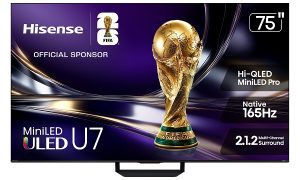
The Hisense U7SG is a 2026 mid-range Mini-LED television positioned below Hisense’s more premium U8 series. It combines 4K resolution, quantum-dot color technology, local dimming, and a native 165Hz refresh rate. Its combination of picture quality and gaming capabilities makes it an attractive option for buyers who want many high-end TV features without necessarily paying for a flagship model.
One of the U7SG’s most distinctive features is its matte anti-reflective screen on the 55-, 65-, 75-, and 85-inch versions. Unlike a conventional glossy display, the matte finish is designed to diffuse reflections from windows, lamps, and other light sources. This can make a noticeable difference when watching TV during the day, particularly in living rooms where controlling ambient light is difficult. The 100- and 116-inch versions have a glossy screen finish, so their reflection handling differs from that of the smaller models.
The U7SG also offers impressive brightness for a mid-range television. Hisense advertises peak brightness of up to 3,000 nits for several screen sizes, including the 65-, 75-, 85-, and 100-inch models. The 55-inch version is advertised at up to 2,000 nits, while the 116-inch version reaches up to 4,000 nits. Actual brightness measurements vary depending on screen size, HDR window size, picture settings, and testing conditions.
The U7SG is also well equipped for gaming. It supports a native 165Hz refresh rate, HDMI 2.1 bandwidth across all four HDMI inputs, variable refresh rate (VRR), Auto Low Latency Mode (ALLM), and AMD FreeSync Premium Pro. Compatible gaming PCs can take advantage of high refresh rates, while console gamers benefit from features designed to deliver smooth, responsive gameplay. Google TV provides access to popular streaming services and a broad selection of applications.
For audio, the U7SG features a built-in speaker system with Dolby Atmos support. Hisense also highlights audio tuning by Devialet. Overall, the Hisense U7SG is particularly appealing to viewers who prioritize reflection handling, strong everyday picture quality, and comprehensive gaming connectivity.
| Hisense U7SG Prices | |
| 116-Inch (116U7SG) | Check Today’s Price… |
| 100-Inch (100U7SG) | Check Today’s Price (Amazon.com)… |
| 85-Inch (85U7SG) | Check Today’s Price (Amazon.com)… |
| 75-Inch (75U7SG) | Check Today’s Price (Amazon.com)… |
| 65-Inch (65U7SG) | Check Today’s Price (Amazon.com)… |
| 55-Inch (55U7SG) | Check Today’s Price… |
Hisense U8QG Short Overview
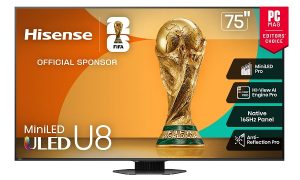
The Hisense U8QG is a premium Mini-LED television introduced in 2025. Positioned above the U7 series in Hisense’s lineup, it is designed to deliver powerful HDR highlights, high contrast, vivid quantum-dot colors, and an immersive built-in audio experience. Hisense advertises peak brightness of up to 5,000 nits, although actual performance depends on screen size, picture settings, and measurement conditions.
The U8QG’s main picture-quality advantage is its exceptional brightness potential. Its MiniLED Pro backlight and full-array local dimming system are designed to control light more precisely, producing bright highlights alongside darker areas of the image. This is particularly useful for HDR movies, dramatic television scenes, and sports viewed in a brightly lit room. It also supports quantum-dot color technology, which helps produce rich, vibrant colors across a wide range of content.
Like the U7SG, the U8QG features a native 165Hz refresh rate and supports high-refresh-rate gaming. It offers HDMI 2.1 connectivity, VRR, ALLM, and AMD FreeSync Premium Pro. Hisense also includes Anti-Reflection Pro technology to help reduce glare. However, independent testing identifies the U8QG’s screen as glossy, while the standard 55- to 85-inch U7SG versions use a matte finish. This difference can matter when direct reflections are a concern.
Audio is another area where the U8QG stands out. Hisense equips it with a 4.1.2-channel multi-speaker system rated at up to 82 watts, together with Dolby Atmos support. This more elaborate built-in audio configuration can provide a more immersive starting point than a typical TV speaker system, although a dedicated soundbar or surround system may still be preferable for serious home theater enthusiasts. Available in 55-, 65-, 75-, 85-, and 100-inch sizes, the U8QG is aimed at buyers seeking premium brightness, powerful built-in sound, and advanced gaming features.
| Hisense U8QG Prices | |
| 100-inch (100U8QG) | Check Today’s Price (Amazon.com)… |
| 85-inch (85U8QG) | Check Today’s Price (Amazon.com)… |
| 75-inch (75U8QG) | Check Today’s Price (Amazon.com)… |
| 65-inch (65U8QG) | Check Today’s Price (Amazon.com)… |
| 55-inch (55U8QG) | Check Today’s Price (Amazon.com)… |
Hisense U7SG vs U8QG Specs Comparison
Before deciding which model offers better value, let’s compare their key specifications. Both TVs share 4K resolution, Mini-LED backlighting, quantum-dot colors, Google TV, and a native 165Hz refresh rate. Their main differences involve advertised peak brightness, screen finish, built-in audio, and connectivity.
| Feature | Hisense U7SG | Hisense U8QG | |||||||||||
| Model year | 2026 | 2025 | |||||||||||
| Product tier | Mid-range | Premium | |||||||||||
| Available sizes | 55″, 65″, 75″, 85″, 100″, 116″ | 55″, 65″, 75″, 85″, 100″ | |||||||||||
| Display technology | Mini-LED / QLED | MiniLED Pro / QLED | |||||||||||
| Resolution | 4K UHD (3840 × 2160) | 4K UHD (3840 × 2160) | |||||||||||
| Panel type | LCD | LCD | |||||||||||
| Screen finish | Matte on 55″–85″; glossy on 100″ and 116″ | Glossy | |||||||||||
| Advertised peak brightness | Up to 3,000 nits | Up to 5,000 nits | |||||||||||
| Local dimming | Yes | Yes | |||||||||||
| Native refresh rate | 165Hz | 165Hz | |||||||||||
| Maximum advertised gaming refresh rate | Up to 330Hz at 1080p | Up to 288Hz at 1080p | |||||||||||
| HDR formats | Dolby Vision, Dolby Vision IQ, HDR10, HDR10+, HDR10+ Adaptive, HLG | Dolby Vision, Dolby Vision IQ, HDR10, HDR10+, HDR10+ Adaptive, HLG | |||||||||||
| Gaming features | VRR, ALLM, FreeSync Premium Pro | VRR, ALLM, FreeSync Premium Pro | |||||||||||
| HDMI connectivity | 4 × HDMI 2.1 | 3 × HDMI 2.1 | |||||||||||
| Smart TV platform | Google TV | Google TV | |||||||||||
| Built-in audio | Multi-channel audio; configuration varies | 4.1.2-channel, up to 82W | |||||||||||
| Dolby Atmos | Yes | Yes | |||||||||||
| Best suited for | Reflection handling and gaming flexibility | Maximum brightness and powerful built-in audio | |||||||||||
| Price |
|
|
What Are the Differences Between Hisense U7SG and U8QG?
The most important differences between the Hisense U7SG and U8QG are their screen finishes, peak brightness, built-in audio systems, and connectivity options. Although the U8QG is the higher-tier television, the U7SG has several practical advantages that can make it the better purchase for everyday viewing.
1. U7SG Has Better Reflection Handling on Standard Screen Sizes
The most noticeable difference is their screen finish. The Hisense U7SG uses a matte anti-reflective coating on its 55- to 85-inch versions, while the U8QG uses a glossy screen with Anti-Reflection Pro technology. These approaches handle ambient light differently, and independent testing indicates that the U7SG does a better job of reducing distracting direct reflections.
This gives the standard U7SG models an advantage in living rooms with large windows, overhead lighting, or lamps positioned near the television. Their matte screen can make the picture easier to watch during daylight hours without constantly adjusting curtains or blinds. The U8QG remains a very bright TV that can overcome substantial ambient light, but its glossy finish can make reflections more noticeable in certain room layouts.
For buyers who frequently watch TV during the day, the matte-screen U7SG models are the more appealing option for reflection handling. However, the 100- and 116-inch U7SG models also use glossy screens, so this advantage does not apply equally to every U7SG size.
2. U8QG Has Higher Advertised Peak Brightness
The Hisense U8QG has a clear advantage in advertised peak brightness, reaching up to 5,000 nits compared with up to 3,000 nits for several U7SG screen sizes. These are manufacturer-rated maximums rather than guaranteed measurements under every viewing condition. The U7SG’s advertised brightness varies by size, with ratings of up to 2,000 nits for the 55-inch model and up to 4,000 nits for the 116-inch model.
The U8QG’s higher brightness potential helps HDR highlights appear more intense, particularly in scenes featuring sunlight, reflections, explosions, and other bright objects against darker backgrounds. It can also be useful in rooms with substantial ambient light, where a powerful display helps preserve picture visibility.
However, peak brightness alone does not determine overall picture quality. Independent testing and direct comparison indicate that the U7SG has more accurate brightness tracking, better reflection handling, and better uniformity, while the U8QG offers substantially greater brightness headroom. For most buyers, the U8QG is the stronger option if maximum HDR brightness is the priority, but the U7SG can still deliver an excellent viewing experience without matching its advertised peak.
3. U8QG Has a More Powerful Built-In Audio System
Another important difference is built-in sound. The Hisense U8QG features a 4.1.2-channel speaker system rated at up to 82 watts, while the U7SG uses a multi-channel audio configuration that varies by screen size.
The U8QG’s additional speaker channels and greater advertised output provide a more elaborate audio setup directly inside the television. This can be particularly useful for viewers who want fuller sound and a more immersive experience without immediately purchasing a separate soundbar.
The U7SG remains suitable for everyday television programs, streaming, and gaming, but its built-in audio is less of a selling point compared with the U8QG. If sound quality matters as much as picture quality and you prefer not to use external speakers, the U8QG has the stronger specification. Keep in mind that advertised wattage alone does not establish which TV sounds better in every room.
4. U7SG Offers Four HDMI 2.1 Inputs
The Hisense U7SG has four HDMI 2.1 inputs, while the U8QG offers three HDMI 2.1 inputs. Both televisions support a native 165Hz refresh rate and advanced gaming features, but the additional HDMI input gives the U7SG more flexibility for users with several connected devices.
For users with multiple gaming devices, this gives the U7SG a practical advantage. You can connect a PlayStation 5, Xbox Series X, gaming PC, and another compatible HDMI device without relying as heavily on an external switch or frequently changing cables.
The U8QG still offers excellent gaming capabilities, including VRR, ALLM, and FreeSync Premium Pro. Its three HDMI 2.1 inputs should be sufficient for many households, but the U7SG is more convenient if you want to connect several modern gaming devices simultaneously.
5. U7SG Is the Newer Mid-Range Model, While U8QG Is the Premium Option
The U7SG belongs to Hisense’s 2026 lineup, whereas the U8QG is a 2025 premium model. This difference in positioning helps explain why the U8QG emphasizes exceptionally high brightness and more elaborate built-in audio, while the U7SG focuses on a combination of picture quality, reflection handling, and gaming versatility.
The U7SG is worth considering if you want a newer model with practical advantages for everyday use. Its matte screen on standard sizes is particularly useful in bright rooms, and its four HDMI 2.1 inputs make it a flexible choice for gaming setups. The U8QG, meanwhile, remains attractive to viewers who prioritize premium HDR brightness and a more powerful built-in sound system.
Actual retail prices and discounts will ultimately determine which model delivers better value. If the U8QG is available at a similar price, its brightness and audio advantages may justify the extra investment. If it costs considerably more, the U7SG offers a compelling alternative for buyers who do not need the U8QG’s additional performance headroom.
Is Hisense U7SG a Better Choice?
If you’re looking for a well-rounded Mini-LED TV with excellent gaming capabilities and better reflection handling on standard screen sizes, the Hisense U7SG is the better choice for many buyers. Its matte anti-reflective screen on the 55- to 85-inch versions helps reduce distracting reflections, making it particularly suitable for bright living rooms. It also offers a native 165Hz refresh rate, four HDMI 2.1 inputs, VRR, and FreeSync Premium Pro for a flexible gaming experience. With manufacturer-rated peak brightness of up to 3,000 nits on several screen sizes, the U7SG can deliver bright, vibrant HDR images without requiring you to step up to the more expensive U8 series. Although its brightness and built-in audio do not match the U8QG’s premium specifications, I recommend the Hisense U7SG if you prioritize reflection handling, gaming connectivity, and overall value.
| Hisense U7SG Prices | |
| 116-Inch (116U7SG) | Check Today’s Price… |
| 100-Inch (100U7SG) | Check Today’s Price (Amazon.com)… |
| 85-Inch (85U7SG) | Check Today’s Price (Amazon.com)… |
| 75-Inch (75U7SG) | Check Today’s Price (Amazon.com)… |
| 65-Inch (65U7SG) | Check Today’s Price (Amazon.com)… |
| 55-Inch (55U7SG) | Check Today’s Price… |
The Hisense U8QG is the better choice if you want higher peak brightness and a more powerful built-in audio system. Its manufacturer-advertised peak brightness of up to 5,000 nits gives it greater HDR brightness potential than the U7SG’s up-to-3,000-nit rating on several screen sizes, while its 4.1.2-channel, up-to-82W speaker system provides a more elaborate built-in audio setup. It also retains a native 165Hz refresh rate and advanced gaming features, making it a compelling option for premium home entertainment. However, its glossy screen may produce more noticeable direct reflections than the matte-screen U7SG models, and it has three HDMI 2.1 inputs rather than four. Choose the U8QG if maximum HDR brightness and built-in sound quality are your priorities, particularly if you can find it at a competitive price.
| Hisense U8QG Prices | |
| 100-inch (100U8QG) | Check Today’s Price (Amazon.com)… |
| 85-inch (85U8QG) | Check Today’s Price (Amazon.com)… |
| 75-inch (75U8QG) | Check Today’s Price (Amazon.com)… |
| 65-inch (65U8QG) | Check Today’s Price (Amazon.com)… |
| 55-inch (55U8QG) | Check Today’s Price (Amazon.com)… |