The TCL QM8L and TCL QM9K are two premium Mini-LED TVs designed for viewers who want outstanding brightness, strong contrast, vibrant colors, and advanced gaming features. However, these models belong to different generations. The TCL QM8L is a 2026 model featuring newer Super Quantum Dot (SQD) Mini-LED technology, while the TCL QM9K is a 2025 flagship QD-Mini LED TV known for its exceptionally high advertised peak brightness and extensive local dimming capabilities.
The TCL QM8L sits above the more affordable TCL QM7L in TCL’s 2026 lineup, while the TCL QM9K sits above the TCL QM8K in the 2025 lineup. The QM8L also serves as the successor to the QM8K, introducing a newer color system, updated backlight control, and four full-bandwidth HDMI 2.1 ports. Meanwhile, the QM9K maintains an advantage in advertised peak brightness and maximum local dimming-zone count. So, should you choose the newer QM8L or save money by choosing the still-powerful QM9K? Let’s compare their features, specifications, and key differences to find out.
TCL QM8L Short Overview
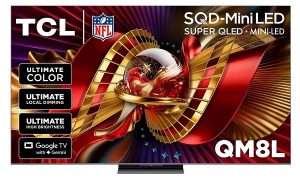
The TCL QM8L is a premium SQD-Mini LED TV introduced for 2026. Positioned above the TCL QM7L, it combines Super Quantum Dot technology with an advanced Mini-LED backlight system to deliver vivid colors, high brightness, and precise contrast control. TCL advertises peak brightness of up to 6,000 nits and up to 4,000+ local dimming zones, although actual performance varies by screen size and viewing conditions.
One of the QM8L’s most important features is its TCL Deep Color System, which combines Super Quantum Crystals, an UltraColor Filter, and an advanced color purity algorithm. TCL rates its color system for 100% BT.2020 color coverage, helping the TV reproduce a particularly wide range of colors. Its Enhanced Halo Control System is also designed to improve the management of light around bright objects against dark backgrounds, helping preserve contrast in challenging HDR scenes.
The QM8L is well equipped for movies and gaming. It supports 4K resolution, a native 144Hz refresh rate, Dolby Vision IQ, HDR10+, HDR10, and HLG. Google TV provides access to popular streaming applications, while its four full-bandwidth HDMI 2.1 ports support 4K gaming at up to 144Hz. This makes the QM8L particularly appealing to households that regularly switch between multiple gaming consoles, a gaming PC, and other home entertainment devices.
Audio is another area where the QM8L offers a premium feature set. TCL includes sound by Bang & Olufsen and compatibility with Dolby Atmos FlexConnect, allowing users to expand their audio setup with compatible speakers and a subwoofer. Available in 65-, 75-, 85-, and 98-inch screen sizes, the QM8L is designed for buyers who want a large-screen TV with advanced picture processing, strong HDR performance, and comprehensive gaming connectivity.
| TCL QM8L Prices | |
| 98-inch (98QM8L) | Check Today’s Price (Amazon.com)… |
| 85-inch (85QM8L) | Check Today’s Price (Amazon.com)… |
| 75-inch (75QM8L) | Check Today’s Price (Amazon.com)… |
| 65-inch (65QM8L) | Check Today’s Price (Amazon.com)… |
TCL QM9K Short Overview
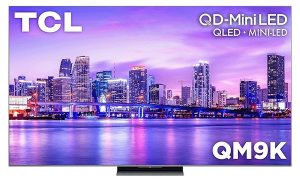
The TCL QM9K is a flagship QD-Mini LED TV from 2025, positioned above the TCL QM8K in that generation’s lineup. It was designed to deliver exceptional HDR brightness, deep blacks, and impressive contrast through its quantum-dot color technology and sophisticated local dimming system. TCL advertises peak brightness of up to 6,500 nits and as many as 6,000 local dimming zones, making the QM9K particularly attractive for bright living rooms and demanding HDR viewing.
Unlike the QM8L, the QM9K does not use TCL’s newer SQD color system. Instead, it relies on conventional QD-Mini LED technology, a CrystGlow WHVA panel, and TCL’s AiPQ Pro processor. Nevertheless, the QM9K remains a highly capable display, delivering vibrant quantum-dot colors, impressive brightness, and detailed highlights in HDR movies and television programs. Its extensive local dimming capabilities also help it maintain strong contrast across a variety of scenes.
The QM9K has a strong set of gaming features, including a native 144Hz refresh rate, VRR, FreeSync Premium Pro, ALLM, and Game Accelerator 288. It supports Dolby Vision IQ, HDR10+, HDR10, HLG, and IMAX, while Google TV provides a familiar smart TV experience. However, one notable limitation is its connectivity: only two of its four HDMI ports offer full HDMI 2.1 bandwidth, while the other two use HDMI 2.0.
For audio, the QM9K also features sound by Bang & Olufsen and supports Dolby Atmos FlexConnect. Its available screen sizes match those of the QM8L at 65, 75, 85, and 98 inches. As an older flagship model, the QM9K can be an attractive alternative when retailers offer substantial discounts, especially for buyers who prioritize exceptional brightness and local dimming performance over the latest color technology and more comprehensive HDMI 2.1 connectivity.
| TCL QM9K Prices | |
| 98-inch (98QM9K) | Check Today’s Price (Amazon.com)… |
| 85-inch (85QM9K) | Check Today’s Price (Amazon.com)… |
| 75-inch (75QM9K) | Check Today’s Price (TCL.com)… |
| 65-inch (65QM9K) | Check Today’s Price (Amazon.com)… |
TCL QM8L vs QM9K Specs Comparison
To better understand how these two premium TCL TVs compare, let’s look at their key specifications side by side. Although both feature 4K resolution, 144Hz refresh rates, Google TV, quantum-dot color technology, and advanced Mini-LED backlighting, the QM8L introduces newer SQD technology and more comprehensive HDMI 2.1 connectivity, while the QM9K offers higher advertised peak brightness and more advertised local dimming zones.
| Feature | TCL QM8L | TCL QM9K | ||||||||
| Model Year | 2026 | 2025 | ||||||||
| Available Sizes | 65″, 75″, 85″, 98″ | 65″, 75″, 85″, 98″ | ||||||||
| Display Technology | SQD-Mini LED | QD-Mini LED | ||||||||
| Resolution | 4K UHD (3840 × 2160) | 4K UHD (3840 × 2160) | ||||||||
| Panel | WHVA 2.0 Ultra | CrystGlow WHVA | ||||||||
| Color Technology | TCL Deep Color System, Super Quantum Crystals | Quantum Dot | ||||||||
| Advertised Peak Brightness | Up to 6,000 nits | Up to 6,500 nits | ||||||||
| Local Dimming | 4,000+ zones | Up to 6,000 zones | ||||||||
| Backlight Control | Enhanced Halo Control | LD6000 Precise Dimming | ||||||||
| Picture Processor | TSR AI Pro Processor | TCL AiPQ Pro Processor | ||||||||
| Native Refresh Rate | 144Hz | 144Hz | ||||||||
| HDR Formats | Dolby Vision IQ, HDR10+, HDR10, HLG | Dolby Vision IQ, HDR10+, HDR10, HLG, IMAX | ||||||||
| Gaming Features | VRR, ALLM, FreeSync Premium Pro, Game Accelerator 288 | VRR, ALLM, FreeSync Premium Pro, Game Accelerator 288 | ||||||||
| HDMI Connectivity | 4 × HDMI 2.1 | 2 × HDMI 2.1, 2 × HDMI 2.0 | ||||||||
| Maximum Advertised Gaming Refresh Rate | 4K at 144Hz; up to 288Hz VRR at 1080p | 4K at 144Hz; up to 288Hz VRR at 1080p | ||||||||
| Smart TV Platform | Google TV | Google TV | ||||||||
| Audio System | Bang & Olufsen | Bang & Olufsen | ||||||||
| Dolby Atmos FlexConnect | Yes | Yes | ||||||||
| Price |
|
|
Note: Brightness and local dimming-zone figures are advertised series maximums and may vary by screen size.
What Are the Differences Between TCL QM8L and QM9K?
Although the TCL QM8L and QM9K share many premium features, their main differences come down to display technology, brightness, local dimming, gaming connectivity, and price. The QM8L introduces TCL’s newer SQD-Mini LED technology, while the QM9K relies on its established QD-Mini LED system. Here are the most important differences to consider.
1. Newer SQD-Mini LED Color Technology
The biggest generational change in the TCL QM8L is its use of SQD-Mini LED technology. Its Super Quantum Crystals and UltraColor Filter are designed to deliver a wider color gamut and improved color purity. TCL rates the QM8L’s color system for 100% BT.2020 coverage, giving it a strong advantage on paper for reproducing saturated colors in demanding HDR content.
The QM9K still produces vibrant images thanks to its quantum-dot display technology, but it does not incorporate the newer SQD system. In practical terms, the QM8L is the more appealing option if you want TCL’s latest color technology for colorful movies, animated content, nature documentaries, and HDR games. However, advertised color coverage does not automatically guarantee better accuracy in every scene, so calibration and real-world viewing conditions still matter.
2. QM9K Has Higher Advertised Peak Brightness
Peak brightness is one area where the older QM9K retains an advantage on paper. TCL advertises up to 6,500 nits for the QM9K, compared with up to 6,000 nits for the QM8L. These figures represent advertised maximums, and actual brightness depends on screen size, HDR window, picture settings, and measurement conditions.
Both TVs are designed to deliver a powerful HDR experience, with bright highlights and strong visibility in well-lit rooms. The QM9K’s higher advertised peak gives it an advantage in maximum brightness specifications, but that alone does not establish that it will look better overall. The QM8L’s newer color system and backlight control also influence how bright colors and HDR highlights appear. For most buyers, these TVs should be evaluated as competing premium displays rather than assuming that a difference of 500 advertised nits automatically determines the winner.
3. Different Local Dimming and Halo Control Systems
The TCL QM9K advertises up to 6,000 local dimming zones, while the QM8L advertises up to 4,000+ zones. A higher zone count can provide more localized control over the backlight, potentially improving black levels and reducing blooming around bright objects on dark backgrounds. This is one of the QM9K’s strongest specifications.
However, the QM8L introduces TCL’s Enhanced Halo Control System, which is designed to improve the precision of backlight transitions and light management. The number of zones is only one part of local dimming performance; processing algorithms, panel characteristics, and zone response also matter. Therefore, it would be misleading to conclude that the QM9K necessarily produces better contrast simply because it advertises more zones. The two models use different generations of backlight control, and their actual performance depends on the scene being displayed.
4. QM8L Offers Four Full-Bandwidth HDMI 2.1 Ports
The QM8L has a clear advantage for users with several modern gaming devices. All four of its HDMI ports support HDMI 2.1 bandwidth, with 4K gaming at up to 144Hz supported across the inputs. This makes it easier to connect a PlayStation 5, Xbox Series X, gaming PC, and another compatible device without having to move cables or compromise on input capabilities.
The QM9K has four HDMI ports, but only two support full HDMI 2.1 bandwidth. It supports 4K gaming at up to 144Hz through its high-bandwidth inputs, as well as up to 288Hz VRR gaming at 1080p. This makes it capable of high-refresh-rate gaming, although its two full-bandwidth ports offer less flexibility for users with multiple gaming devices.
5. Different Picture Processors
TCL equips the QM8L with its TSR AI Pro Processor, while the QM9K uses the AiPQ Pro Processor. Both are designed to improve image processing, including upscaling, detail enhancement, and picture optimization. However, the QM8L’s processor is part of a newer display system that works alongside its SQD color technology and Enhanced Halo Control.
The QM9K’s processor remains capable of handling 4K content, streaming video, and demanding HDR scenes. The newer processor name alone does not prove that the QM8L will outperform the QM9K in every processing task, but the QM8L benefits from being designed around TCL’s latest display architecture. Buyers specifically seeking the newest TCL picture technology should lean toward the QM8L.
6. QM9K May Offer Better Value at a Discount
As a 2025 flagship, the QM9K may be available at a lower price than the newer QM8L, particularly during retailer clearance sales. Its high advertised brightness, extensive local dimming, quantum-dot color, and premium audio features make it a compelling option when the price difference is substantial.
The QM8L costs more as a newer-generation model, but that premium buys you SQD-Mini LED technology, TCL’s newer color system and backlight control, and four full-bandwidth HDMI 2.1 ports. If the price gap is small, the QM8L is easier to recommend because it combines newer display technology with more versatile connectivity. If the QM9K is heavily discounted, however, it could be the smarter purchase for buyers who prioritize brightness and contrast over the newest technology.
Which One Should You Choose?
If you’re looking for a newer premium Mini-LED TV with the latest display technology, the TCL QM8L is the better choice. Its SQD-Mini LED system combines Super Quantum Crystals with an UltraColor Filter to deliver impressive color capabilities, while its Enhanced Halo Control System is designed to improve backlight precision. With advertised peak brightness of up to 6,000 nits, up to 4,000+ local dimming zones, and a native 144Hz refresh rate, the QM8L offers an impressive combination of brightness, color, and gaming performance. Its four full-bandwidth HDMI 2.1 ports are another major advantage for users connecting multiple modern gaming devices. For buyers who want TCL’s latest color technology, flexible connectivity, and a TV designed around a newer display architecture, the QM8L is the model I would recommend.
| TCL QM8L Prices | |
| 98-inch (98QM8L) | Check Today’s Price (Amazon.com)… |
| 85-inch (85QM8L) | Check Today’s Price (Amazon.com)… |
| 75-inch (75QM8L) | Check Today’s Price (Amazon.com)… |
| 65-inch (65QM8L) | Check Today’s Price (Amazon.com)… |
The TCL QM9K is still worth considering if you can find it at a significantly lower price. Its advertised peak brightness of up to 6,500 nits and up to 6,000 local dimming zones make it a formidable option for HDR movies and bright-room viewing. It also retains a native 144Hz refresh rate, VRR, FreeSync Premium Pro, Google TV, and sound by Bang & Olufsen. Although it lacks the newer SQD color system and has fewer full-bandwidth HDMI 2.1 ports, its existing QD-Mini LED technology still delivers a premium viewing experience. Choose the QM9K if its discount is substantial and your priorities are high brightness, strong contrast, and excellent HDR performance rather than having the latest generation of display technology.
| TCL QM9K Prices | |
| 98-inch (98QM9K) | Check Today’s Price (Amazon.com)… |
| 85-inch (85QM9K) | Check Today’s Price (Amazon.com)… |
| 75-inch (75QM9K) | Check Today’s Price (TCL.com)… |
| 65-inch (65QM9K) | Check Today’s Price (Amazon.com)… |