Premium TVs are all about delivering the best possible picture quality, smart processing, and long-lasting value. Sony’s lineup at the high end has split into two flagship directions: OLED for perfect contrast and cinematic immersion, and Mini LED for extreme brightness and versatility in bright rooms.
The Sony BRAVIA 8 II (2025) builds directly on the success of the BRAVIA 8 (2024) with a big upgrade to QD-OLED technology, bringing higher brightness and richer colour volume. Meanwhile, the Sony BRAVIA 9 (2024) continues as Sony’s most powerful Mini LED TV, sitting above the BRAVIA 7 — engineered to excel with stunning peak brightness and large screen sizes.
So which one should you actually buy today? Let’s break down how the BRAVIA 8 II and BRAVIA 9 stack up in real-world performance.
Sony BRAVIA 8 II (2025) Short Overview
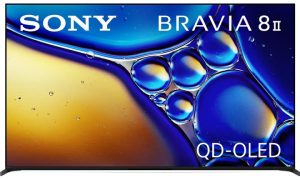
The Sony BRAVIA 8 II is the newest OLED flagship from Sony in 2025, and the biggest upgrade is clear:
it switches to a QD-OLED panel, giving it perfect blacks, superior viewing angles, and noticeably brighter HDR highlights than standard WOLED TVs like the previous BRAVIA 8.
Sony powers the BRAVIA 8 II with its latest XR Processor, boosting clarity, motion, and upscaling so both movies and live sports always look clean and fluid. The expanded XR Triluminos Max colour system helps push colour vibrancy and realism even further.
Design also takes a step forward. The ultra-slim One Slate aesthetic creates a clean and elegant presence whether wall-mounted or on its stand — exactly what you expect from a premium OLED.
Audio gets special treatment through Acoustic Surface Audio+, where the screen itself acts as the speaker. Dialogue sounds like it’s coming directly from actors on-screen, enhancing immersion.
Gaming features like 4K 120 Hz, VRR, ALLM, and PS5-optimized settings are all here. Just note that screen sizes are only 55-inch and 65-inch, making it ideal for living rooms but not oversized home theaters.
| Sony BRAVIA 8 II Prices | |
| 65-inch (K-65XR80M2) | Check Today’s Price (Amazon.com)… |
| 55-inch (K-55XR80M2) | Check Today’s Price (Amazon.com)… |
Sony BRAVIA 9 (2024) Short Overview
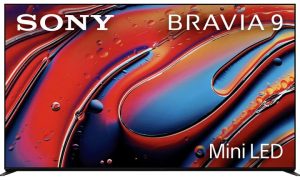
The Sony BRAVIA 9 stands at the top of Sony’s Mini LED TV lineup. It focuses on what LED does best:
ultra-high brightness, glare handling, and bigger size options — making it perfect for bright, spacious rooms.
Its Mini LED panel features Sony’s advanced Backlight Master Drive with precise local dimming, delivering deep contrast while still hitting exceptionally high peak brightness levels. HDR movies and bright scenic content truly pop here.
Colour reproduction remains natural and accurate thanks to Sony’s top-tier processing. And motion handling is excellent, making the BRAVIA 9 great for sports and action content.
Sound is a standout feature: a built-in 2.2.2 speaker system with beam tweeters creates more spacious, vertical audio without requiring an external system — a rarity for LED TVs.
Size options are also a big advantage: 65-inch, 75-inch, and 85-inch versions make it a better match for large rooms and immersive home setups.
| Sony BRAVIA 9 Prices | |
| 85-Inch (K-85XR90) | Check Today’s Price (Amazon.com)… |
| 75-Inch (K-75XR90) | Check Today’s Price (Amazon.com)… |
| 65-Inch (K-65XR90) | Check Today’s Price (Amazon.com)… |
Sony BRAVIA 8 II and BRAVIA 9 Specs Comparison Table
Below is a comparison of key specifications between Sony BRAVIA 8 II (2025) and Sony BRAVIA 9 (2024):
| Feature | Sony BRAVIA 8 II (2025) | Sony BRAVIA 9 (2024) | |||||
| Panel Type | QD-OLED (self-emissive) | Mini LED with Local Dimming | |||||
| Design Style | Ultra-slim premium OLED profile | Premium Mini LED design | |||||
| Black Levels | Perfect blacks | High contrast, slight blooming possible | |||||
| Peak Brightness | Higher than typical OLED | Much brighter — best for bright rooms | |||||
| Colour Performance | Richer colour volume (QD-OLED) | Natural accuracy, vibrant HDR | |||||
| Viewing Angles | Outstanding | Good — improved with X-Wide Angle | |||||
| Gaming Features | 4K 120Hz, VRR, ALLM, PS5 features | 4K 120Hz, VRR, ALLM, PS5 features | |||||
| Sizes Available | 55″, 65″ | 65″, 75″, 85″ | |||||
| Motion / Upscaling | Cognitive Processor XR | Cognitive Processor XR | |||||
| Best For | Home cinema & darker viewing environments | Large rooms & daytime brightness | |||||
| Audio System | Acoustic Surface Audio+ (screen-based sound) | 2.2.2 speakers with beam tweeters | |||||
| Price | Higher (newer OLED flagship) | Lower (more discount potential) | |||||
|
|
The Differences Between BRAVIA 8 II and BRAVIA 9
When deciding between these two TVs, here are the key differences you should consider:
- Panel Technology & Black Levels vs Bright-Room Performance
The BRAVIA 8 II uses a QD-OLED panel, which delivers perfect blacks, extreme contrast, and excellent viewing angles — ideal for cinematic viewing and scenes with deep shadow. On the other hand, the BRAVIA 9 uses a Mini LED backlit panel with local dimming, which cannot match OLED’s pixel-level blacks but offers much higher peak brightness and better performance under ambient light or in bright rooms. - Brightness & HDR / Lighting Conditions
With its Mini LED backlight system, BRAVIA 9 shines when it comes to brightness: HDR highlights pop more, scenes remain punchy even when there’s room lighting, and glare/reflection handling tends to be superior. BRAVIA 8 II, while brighter than many traditional OLEDs, still performs best in dim or moderately lit rooms — for a more cinematic, controlled viewing environment. - Screen Size Options & Room Suitability
BRAVIA 9 is available in larger sizes (e.g. up to 75″ / 85″), which makes it more suitable for spacious living rooms or home-theatre style setups. Meanwhile, BRAVIA 8 II is limited to 55″ and 65″, making it a great fit for smaller or medium-sized rooms, but less ideal if you want a truly large-screen cinematic feel. - Sound System and Built-in Audio Experience
BRAVIA 8 II uses Acoustic Surface Audio+, where the screen itself vibrates to produce sound — this tends to give a very immersive, screen-anchored audio experience that’s especially good for cinematic content. BRAVIA 9, in contrast, relies on a dedicated 2.2.2-channel speaker system with beam tweeters, which usually produces stronger, more room-filling sound — a plus if you prefer to skip a soundbar but still want robust audio in a larger room. - Design, Aesthetic and Overall Use-Case Focus
The slim, minimal “One Slate” design of BRAVIA 8 II highlights its premium OLED identity and suits modern, sleek interior setups — ideal for a dedicated movie or media room. BRAVIA 9’s design is still premium, but the larger size and LED-based build make it more suited for versatile, everyday living-room use, especially where screen size and brightness matter more than ultra-deep blacks.
Which One to Choose
If your priority is cinematic picture quality, deep blacks, and a true “movie-theatre” experience — especially in darker or moderately lit rooms — then BRAVIA 8 II is the smarter choice. Its QD-OLED panel, excellent contrast, vibrant colour, and immersive screen-based audio make it ideal for films, series, and cinematic content, delivering that high-end “pure picture” experience you expect from a flagship OLED.
| Sony BRAVIA 8 II Prices | |
| 65-inch (K-65XR80M2) | Check Today’s Price (Amazon.com)… |
| 55-inch (K-55XR80M2) | Check Today’s Price (Amazon.com)… |
On the other hand, if you value brightness, larger screen sizes, and versatility in different lighting conditions — especially for living-room viewing, sports, or family TV time — then BRAVIA 9 is the more practical pick. With its powerful Mini LED backlight, higher luminance, more robust built-in audio, and bigger 65″–75″+ size options, it caters better to bright-room environments, large spaces, or mixed content usage.
| Sony BRAVIA 9 Prices | |
| 85-Inch (K-85XR90) | Check Today’s Price (Amazon.com)… |
| 75-Inch (K-75XR90) | Check Today’s Price (Amazon.com)… |
| 65-Inch (K-65XR90) | Check Today’s Price (Amazon.com)… |