Sony continues to expand its premium TV lineup with different display technologies designed for different viewing environments. Two models worth comparing are the Sony BRAVIA 9 II and the Sony BRAVIA 8 II. The BRAVIA 9 II is Sony’s flagship 2026 RGB Mini LED TV, while the BRAVIA 8 II is a premium QD-OLED TV introduced in 2025. Both deliver 4K resolution, advanced picture processing, Dolby Vision HDR, and Google TV, but they approach picture quality in very different ways.
Although the BRAVIA 9 II is positioned above the BRAVIA 7 II in Sony’s 2026 TV lineup, that doesn’t automatically make it the better choice for every buyer. Its RGB Mini LED technology emphasizes high brightness, vivid colors, and improved visibility in bright rooms, whereas the BRAVIA 8 II’s QD-OLED panel delivers pixel-level black control and excellent contrast for cinematic viewing. So, which Sony TV should you choose? Let’s compare their specifications, picture quality, gaming features, sound, and overall value.
Sony BRAVIA 9 II (2026) Short Overview
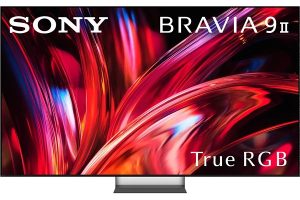
The Sony BRAVIA 9 II is Sony’s flagship RGB Mini LED TV for 2026. It sits above the BRAVIA 7 II in Sony’s current lineup and introduces a more advanced backlighting system that uses independently controlled red, green, and blue LEDs. Sony calls this technology RGB Backlight Master Drive Pro. Instead of relying on a conventional white or blue LED backlight combined with color-conversion layers, the RGB system uses dedicated red, green, and blue light sources to produce colors more directly.
One of the biggest advantages of the BRAVIA 9 II is its potential for very high brightness and vivid color reproduction. Its RGB Mini LED system is designed to deliver intense highlights while maintaining rich colors in HDR content. This makes the TV particularly appealing for bright living rooms, sports, and movies with demanding HDR scenes. Sony’s local dimming technology also helps control contrast across different parts of the screen, although the backlight still operates in zones rather than controlling every pixel independently as an OLED panel does.
The BRAVIA 9 II uses Sony’s XR Processor to analyze and optimize picture quality. Sony’s processing technologies are designed to improve detail, color, contrast, and motion while preserving the natural appearance of movies and television programs. The TV supports 4K resolution and HDR formats including Dolby Vision, HDR10, and HLG. The BRAVIA 9 II features Sony’s Immersive Black Screen Pro anti-reflection treatment on its 65-inch, 75-inch, and 85-inch models, helping reduce distracting reflections in bright rooms. The 115-inch model does not include this particular screen treatment. However, local dimming can still produce some blooming around bright objects against dark backgrounds, unlike OLED technology.
For gaming, the BRAVIA 9 II supports a native 120Hz refresh rate, Variable Refresh Rate (VRR), and Auto Low Latency Mode (ALLM). Its HDMI connectivity includes four ports, with HDMI 2.1 gaming features available on two ports. These features make it suitable for PlayStation 5, Xbox Series X, and compatible gaming PCs, although the limited number of full-bandwidth HDMI 2.1 connections may require some planning if you use several high-bandwidth devices. Sony’s gaming features also include automatic HDR tone mapping and automatic genre picture mode for compatible PlayStation 5 setups.
The BRAVIA 9 II runs Google TV, giving users access to popular streaming services, voice search, Chromecast built-in, and a broad selection of entertainment apps. It also offers Sony’s premium sound features, including Acoustic Center Sync compatibility with supported Sony soundbars. The BRAVIA 9 II is available in 65-inch, 75-inch, 85-inch, and 115-inch sizes in the US market, making it the more flexible choice for buyers who want a very large screen. Its premium RGB Mini LED technology and flagship positioning, however, mean that it generally commands a higher price than the BRAVIA 8 II.
| Sony BRAVIA 9 II Prices | |
| 115-Inch (K-115XR90M2) | Check Today’s Price (ABT.com)… |
| 85-Inch (K-85XR90M2) | Check Today’s Price (ABT.com)… |
| 75-Inch (K-75XR90M2) | Check Today’s Price (ABT.com)… |
| 65-Inch (K-65XR90M2) | Check Today’s Price (ABT.com)… |
Sony BRAVIA 8 II (2025) Short Overview
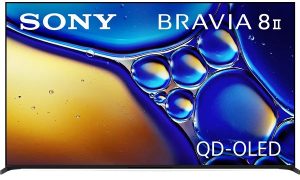
The Sony BRAVIA 8 II belongs to Sony’s 2025 TV lineup and takes a different approach to premium picture quality. Instead of using an RGB Mini LED backlight, it features a QD-OLED panel, combining OLED’s pixel-level light control with quantum-dot color technology. Each pixel can switch itself on or off, allowing the TV to produce exceptionally deep blacks without requiring a separate backlight. This gives the BRAVIA 8 II a major advantage for dark-room movie watching and scenes with bright highlights against nearly black backgrounds.
The QD-OLED panel is particularly attractive for viewers who prioritize contrast, color depth, and cinematic presentation. Because each pixel controls its own light output, the BRAVIA 8 II can display stars against a dark sky, nighttime scenes, and subtle shadow details without the same type of local-dimming blooming that can occur on Mini LED televisions. Its quantum-dot technology also helps deliver rich, saturated colors. However, OLED technology is generally less suitable than a very bright Mini LED TV for rooms with intense ambient light, especially when displaying large areas of bright content.
Sony equips the BRAVIA 8 II with its XR Processor and picture technologies designed to refine detail, color, contrast, and motion. The TV supports 4K resolution, Dolby Vision, HDR10, and HLG. Its native refresh rate is 120Hz, which provides smooth motion for sports, movies, and compatible games. Sony also includes picture modes intended for different viewing situations, together with calibration-related features that can help users achieve a more accurate picture with supported content and equipment.
Gaming performance is another strength of the BRAVIA 8 II. It supports 4K at 120Hz, VRR, and ALLM through its HDMI connections, making it a capable television for modern consoles. Like the BRAVIA 9 II, it has four HDMI inputs, with the key HDMI 2.1 gaming capabilities concentrated on HDMI 3 and HDMI 4. It also includes PlayStation 5-specific features such as Auto HDR Tone Mapping and Auto Genre Picture Mode. The 120Hz refresh rate is sufficient for most console gaming, although neither model offers the kind of native high-refresh-rate advantage associated with certain gaming-focused televisions.
The BRAVIA 8 II also features Acoustic Surface Audio+, which uses actuators to make the screen itself produce sound, supported by built-in subwoofers. This approach helps position dialogue and other sounds more closely to the action on screen. The TV runs Google TV and supports Dolby Atmos, Chromecast built-in, Apple AirPlay, and Apple HomeKit. In the US, the BRAVIA 8 II is available in 55-inch and 65-inch sizes. Its smaller size selection and lower peak brightness are important considerations, but for viewers who want a premium OLED experience without moving to Sony’s newer flagship RGB Mini LED models, it remains a compelling option.
| Sony BRAVIA 8 II Prices | |
| 65-inch (K-65XR80M2) | Check Today’s Price (Amazon.com)… |
| 55-inch (K-55XR80M2) | Check Today’s Price (Amazon.com)… |
Sony BRAVIA 9 II vs BRAVIA 8 II Specs Comparison
Here’s a quick side-by-side look at how these two premium Sony TVs compare.
| Feature | Sony BRAVIA 9 II | Sony BRAVIA 8 II | ||||||
| Model Year | 2026 | 2025 | ||||||
| Position in Lineup | Flagship RGB Mini LED TV; above BRAVIA 7 II | Premium QD-OLED TV | ||||||
| Available Sizes (US) | 65″, 75″, 85″, 115″ | 55″, 65″ | ||||||
| Resolution | 3840 × 2160 (4K) | 3840 × 2160 (4K) | ||||||
| Display Technology | RGB Mini LED LCD | QD-OLED | ||||||
| Backlight | RGB LED backlight with local dimming | No separate backlight; self-emissive pixels | ||||||
| Picture Processor | Sony XR Processor | Sony XR Processor | ||||||
| Black Level | Very good, with possible blooming | Pixel-level black control | ||||||
| Peak Brightness | Higher | Lower | ||||||
| Color Technology | RGB Backlight Master Drive Pro | Quantum-dot OLED | ||||||
| HDR Formats | HDR10, HLG, Dolby Vision | HDR10, HLG, Dolby Vision | ||||||
| Native Refresh Rate | 120Hz | 120Hz | ||||||
| VRR | Yes | Yes | ||||||
| ALLM | Yes | Yes | ||||||
| HDMI Inputs | 4 | 4 | ||||||
| HDMI 2.1 Gaming Features | Yes, on 2 ports | Yes, on 2 ports | ||||||
| 4K at 120Hz | Yes | Yes | ||||||
| PS5-Specific Features | Auto HDR Tone Mapping, Auto Genre Picture Mode | Auto HDR Tone Mapping, Auto Genre Picture Mode | ||||||
| Screen Finish | Immersive Black Screen Pro (65/75/85-inch) | Glossy | ||||||
| Smart Platform | Google TV | Google TV | ||||||
| Dolby Atmos | Yes | Yes | ||||||
| Built-in Audio Technology | Acoustic Multi-Audio+ | Acoustic Surface Audio+ | ||||||
| Audio Power Output |
80W | 50W | ||||||
| Chromecast Built-in | Yes | Yes | ||||||
| Apple AirPlay | Yes | Yes | ||||||
| Best Viewing Environment | Bright rooms and mixed lighting | Dark or light-controlled rooms | ||||||
| Main Advantage | Brightness, large-screen options, bright-room visibility | Perfect blacks, contrast, cinematic image quality | ||||||
| Main Compromise | Higher price; possible local-dimming blooming | Lower brightness; fewer screen sizes | ||||||
| Price | Generally higher | Generally lower | ||||||
|
|
The Differences Between Sony BRAVIA 9 II and BRAVIA 8 II
Although the Sony BRAVIA 9 II and BRAVIA 8 II both deliver premium 4K picture quality, their different display technologies create several meaningful differences. Here’s how they compare in the areas that matter most when choosing a new TV.
1. Display Technology: RGB Mini LED vs QD-OLED
The biggest difference between these televisions is their display technology. The BRAVIA 9 II uses RGB Mini LED technology, while the BRAVIA 8 II uses QD-OLED. These technologies have different strengths, and the best one depends on the viewing experience you want.
The BRAVIA 9 II uses separate red, green, and blue LEDs in its backlighting system. Its LEDs are controlled in zones, allowing the TV to produce bright images and manage contrast across the screen. This technology is designed to deliver high brightness and strong color reproduction, making it especially suitable for HDR content and rooms with substantial ambient light.
The BRAVIA 8 II takes a different approach. Its QD-OLED panel controls light at the individual-pixel level, so pixels can turn off completely to produce true black. This creates outstanding contrast and helps preserve detail in dark scenes without the halo-like blooming that can appear around bright objects on a local-dimming LCD TV.
For bright-room viewing and large screens, the BRAVIA 9 II has the advantage. For dark-room movie watching, precise blacks, and consistently controlled contrast, the BRAVIA 8 II remains highly attractive.
Winner: Depends on your viewing environment. BRAVIA 9 II for brightness; BRAVIA 8 II for black levels and pixel-level contrast.
2. Brightness and HDR Performance
Brightness is one of the BRAVIA 9 II’s clearest advantages. Its RGB Mini LED backlight is designed to deliver intense highlights and a bright overall picture, helping HDR movies, sports, and daytime television remain vivid in rooms with considerable ambient light. Its Immersive Black Screen Pro treatment on the 65-inch, 75-inch, and 85-inch models also helps reduce distracting reflections.
The BRAVIA 8 II is not designed to compete with the BRAVIA 9 II’s brightness. Instead, its QD-OLED panel focuses on contrast, rich color, and precise light control. HDR highlights can look impressive against deep black backgrounds, but large bright scenes are generally less comfortable for OLED to sustain at the same intensity as a high-performance Mini LED television.
Both TVs support Dolby Vision, HDR10, and HLG, so the difference is not simply about which HDR formats they accept. The more important distinction is how their panels reproduce HDR content. The BRAVIA 9 II is better suited to bright rooms and highly luminous highlights, while the BRAVIA 8 II excels at the contrast and shadow detail that make cinematic HDR viewing so compelling.
Winner: Sony BRAVIA 9 II for brightness and bright-room HDR; BRAVIA 8 II for dark-room contrast.
3. Black Levels, Contrast, and Blooming
The BRAVIA 8 II has an important advantage in black-level performance. Because every OLED pixel produces its own light, it can turn individual pixels off completely. This makes dark scenes look genuinely black and allows bright objects to stand out without a backlight illuminating the surrounding areas.
The BRAVIA 9 II relies on local dimming to control its RGB LED backlight. Although this approach can deliver excellent contrast, the backlight is divided into zones rather than individual pixels. When a bright object appears against a dark background, some light can spill into neighboring areas, creating blooming. The extent of this effect depends on the scene and the TV’s local-dimming behavior.
For movies with dark cinematography, nighttime scenes, and letterboxed films viewed in a dim room, the BRAVIA 8 II is the more natural choice. The BRAVIA 9 II can still deliver an impressive HDR picture, but its greater brightness does not eliminate the fundamental difference between zone-based backlighting and OLED’s pixel-level control.
Winner: Sony BRAVIA 8 II.
4. Color Reproduction
Both TVs are designed to produce rich, accurate colors, but they use different methods to achieve that result. The BRAVIA 9 II’s RGB backlight uses dedicated red, green, and blue LEDs to produce light, giving Sony a new approach to color control and high-brightness color reproduction.
The BRAVIA 8 II uses quantum dots in combination with OLED technology. This allows it to produce saturated colors while retaining the pixel-level black control associated with OLED displays. Color performance can vary depending on brightness, picture settings, and the content being displayed, so neither technology should be judged by color intensity alone.
The BRAVIA 9 II is particularly promising for colorful HDR material in bright environments, where high brightness helps preserve the impact of vivid scenes. The BRAVIA 8 II is equally appealing for cinematic content in a controlled room, where its contrast and color depth help create a more immersive image.
Winner: Both are excellent; BRAVIA 9 II has the advantage in high-brightness color, while BRAVIA 8 II offers outstanding color against OLED blacks.
5. Refresh Rate and Gaming Performance
The gaming specifications are similar on paper. Both TVs feature a native 120Hz refresh rate, VRR, ALLM, and support for 4K gaming at up to 120Hz. These capabilities make either model suitable for modern consoles such as the PlayStation 5 and Xbox Series X.
Both televisions also include four HDMI inputs, but their full HDMI 2.1 gaming capabilities are available on two ports. This is worth considering if you have multiple consoles, a gaming PC, and an eARC-connected soundbar or receiver. Depending on your setup, you may need to plan which devices use the high-bandwidth connections.
In terms of the picture itself, the BRAVIA 8 II’s OLED panel offers pixel-level light control and excellent response characteristics, which can be appealing for fast-moving games. The BRAVIA 9 II combines high brightness with Immersive Black Screen Pro on its 65-inch, 75-inch, and 85-inch models, making those versions particularly practical for gaming during the day or in a brightly lit room. Neither TV has a native refresh-rate advantage over the other, so your room conditions and picture preferences matter more than the headline refresh-rate specification.
Winner: Tie for core gaming features. Choose BRAVIA 8 II for OLED characteristics and dark-room gaming, or BRAVIA 9 II for bright-room gaming.
6. Anti-Reflection Performance and Viewing Environment
The BRAVIA 9 II’s 65-inch, 75-inch, and 85-inch models feature Sony’s Immersive Black Screen Pro treatment, which is designed to reduce distracting reflections. The 115-inch model does not include this treatment, so buyers should not assume that all four sizes offer identical anti-reflection performance.
The BRAVIA 8 II uses a glossy screen. While glossy finishes can preserve a clean, direct-looking image, visible reflections may be more distracting in rooms with uncontrolled lighting. Its OLED panel is particularly rewarding when you can dim the room and let its deep blacks and contrast take center stage.
The distinction is important because the best display technology on paper may not deliver the best experience in every room. If you watch television mostly during the day, the BRAVIA 9 II’s combination of brightness and anti-reflection treatment is a significant advantage. If you generally watch movies in the evening with controlled lighting, the BRAVIA 8 II’s OLED characteristics become more valuable.
Winner: Sony BRAVIA 9 II for bright rooms; BRAVIA 8 II for controlled-light home theaters.
7. Audio Quality
Sony equips both models with premium built-in audio features, but the BRAVIA 8 II has a distinctive approach through Acoustic Surface Audio+. Rather than relying exclusively on conventional speakers positioned behind the screen, it uses actuators to make the display surface produce sound, supported by built-in subwoofers. This helps align dialogue and other audio with the action on screen.
The BRAVIA 9 II also offers a premium integrated audio system and compatibility with Sony’s Acoustic Center Sync feature when paired with supported soundbars. This can help integrate the TV with a compatible external audio system.
The best choice depends partly on whether you intend to use the built-in speakers or connect a dedicated soundbar. Both TVs support Dolby Atmos, but neither should be expected to replace a full home theater system for buyers who want powerful bass and convincing surround sound. For built-in audio, the BRAVIA 8 II’s screen-based sound system is a particularly appealing feature.
Winner: Depends on your preference. The BRAVIA 9 II offers an 80W Acoustic Multi-Audio+ system, while the BRAVIA 8 II features 50W Acoustic Surface Audio+. The BRAVIA 8 II’s screen-based audio is distinctive, but the better-sounding TV ultimately depends on your listening preferences and room.
8. Available Screen Sizes
Screen-size selection is a major practical difference between these two models. The BRAVIA 9 II is available in 65-inch, 75-inch, 85-inch, and 115-inch versions in the US market. This makes it the better option for buyers planning a large-screen home theater or a spacious living room.
The BRAVIA 8 II is offered in 55-inch and 65-inch sizes. That selection makes it more suitable for smaller rooms, bedrooms, and spaces where a 75-inch or larger television would be impractical. It also provides an entry point into Sony’s premium QD-OLED technology without requiring buyers to purchase an enormous screen.
If you want a Sony TV larger than 65 inches, the BRAVIA 9 II is the clear choice between these two models. If you are shopping for a 55-inch television, the BRAVIA 8 II is the only option here.
Winner: Sony BRAVIA 9 II for larger screen sizes; BRAVIA 8 II for buyers who prefer 55 inches.
9. Price and Overall Value
The BRAVIA 9 II occupies a higher position in Sony’s 2026 lineup and introduces newer RGB Mini LED technology. Its high brightness, anti-reflection treatment on the 65-inch, 75-inch, and 85-inch models, and availability in sizes up to 115 inches help justify its premium positioning for buyers who need those capabilities.
The BRAVIA 8 II was introduced in 2025 and uses QD-OLED technology that remains highly competitive for cinematic viewing. Because it is an earlier-generation model, retail discounts may make it particularly attractive, although actual prices vary by screen size, retailer, and sales period. Its smaller size range also means that direct price comparisons should use the same screen size whenever possible.
The BRAVIA 9 II is worth considering if you need high brightness, better visibility in a bright room, or a screen larger than 65 inches. However, buyers who primarily watch movies in a dark room may find that the BRAVIA 8 II delivers the picture characteristics they value most for less money.
Winner: Sony BRAVIA 8 II for value-oriented cinematic viewing; BRAVIA 9 II for buyers who specifically need its brightness and large-screen advantages.
Which One Should You Choose?
If you want the brightest and most versatile large-screen option between these two models, the Sony BRAVIA 9 II is the one to choose. Its RGB Mini LED technology, high brightness, Immersive Black Screen Pro treatment on the 65-inch, 75-inch, and 85-inch models, and screen sizes extending to 115 inches make it particularly suitable for bright living rooms and premium home entertainment setups. It also delivers 4K resolution, Dolby Vision, a 120Hz refresh rate, VRR, and Google TV. If you watch a lot of daytime sports, HDR movies in a bright room, or simply want a much larger screen than 65 inches, the BRAVIA 9 II is the stronger fit.
Sony BRAVIA 9 II — Best for bright rooms, high-brightness HDR, and large-screen viewing.
| Sony BRAVIA 9 II Prices | |
| 115-Inch (K-115XR90M2) | Check Today’s Price (ABT.com)… |
| 85-Inch (K-85XR90M2) | Check Today’s Price (ABT.com)… |
| 75-Inch (K-75XR90M2) | Check Today’s Price (ABT.com)… |
| 65-Inch (K-65XR90M2) | Check Today’s Price (ABT.com)… |
However, the Sony BRAVIA 8 II remains the better choice for many movie enthusiasts. Its QD-OLED panel produces perfect blacks at the pixel level, excellent contrast, and rich colors that look especially impressive in a dark or light-controlled room. Its Acoustic Surface Audio+ system is another notable attraction, while its 55-inch option makes it more flexible for smaller spaces. If you don’t need the BRAVIA 9 II’s greater brightness or larger screen sizes, the BRAVIA 8 II offers a compelling premium viewing experience and may provide better value, particularly when discounted.
Sony BRAVIA 8 II — Best for cinematic contrast, OLED black levels, and value-focused home theater setups.
| Sony BRAVIA 8 II Prices | |
| 65-inch (K-65XR80M2) | Check Today’s Price (Amazon.com)… |
| 55-inch (K-55XR80M2) | Check Today’s Price (Amazon.com)… |